



Behind every successful company is a remarkable sales team who brings in revenue. As any rep will tell you, sales is a demanding job - and if some tasks were lifted off your shoulders or made easier, it would be a huge relief. So how can you actually make that happen?
The answer is AI for sales. While many of your favourite companies already use artificial intelligence for various purposes, sales teams are also using it to close more deals, faster. It removes administrative work, surface useful signals, and give reps better context before they make a decision or interact with a buyer.
Let’s explore how your team can start using AI across the sales funnel - from prospecting to follow-ups - and check out the tools that are already helping others sell smarter.
What is AI for sales?
AI for sales is the use of artificial intelligence to support activities across the sales process by analyzing information, generating content, identifying patterns, making predictions, or carrying out defined tasks.
It helps you analyze your pipeline and understand customer behavior better. With large volumes of data processed in real time, your team can work faster, prioritize smarter, and spend more time selling.
Depending on the system, AI might help a rep research an account, prioritize leads, summarize a sales call, draft a follow-up, identify a deal that may be at risk, recommend a next action, or surface an expansion opportunity. AI is therefore an umbrella term rather than one specific feature. A CRM with generative AI, a conversation-intelligence system, an AI sales agent, and a predictive lead-scoring model may all be described as “AI for sales” while doing very different jobs.
What types of AI are used in sales?
Before looking at specific use cases, it helps to separate the technologies involved.
Predictive AI
Predictive AI uses historical and current data to identify patterns and estimate what may happen next. In sales, this can support lead scoring, deal-risk detection, forecasting, or identifying accounts that may need attention.
Generative AI
Generative AI creates or transforms content. Sales teams can use it to draft emails, summarize meetings, create call recaps, adapt messaging, or turn notes into structured outputs.
Conversational AI
Conversational AI works with natural language to interact with prospects, customers, or salespeople. It can power chat experiences, answer routine questions, collect information, and route conversations.
AI agents
AI agents go beyond a single generated answer or rule-based workflow. They can carry out a sequence of tasks toward a defined goal, often across several systems, within the permissions and controls given to them.
How sales teams can use AI day-to-day
Here are a few practical ways sales teams are already using AI to sell more in less time:
Machine Learning
Just like humans learn from practice, machine learning enables systems to learn from data and identify sales patterns without manual coding.
Say you need to predict which customers are likely to buy again. AI tools can process data on browsing behavior, time on site, past purchases, and engagement to highlight which leads are most likely to convert.
This saves you time on cold leads and helps you zero in on the most promising ones.
Natural language processing (NLP)
Rather than spending time responding to repetitive customer queries, your AI-powered chatbot can handle them using NLP and train itself using your existing call scripts.
That means your team can focus on meaningful conversations and closing high-value deals, while the bot answers FAQs in the background.
Predictive analysis
Need to know who’s about to churn rate or how many deals will close next month?
With predictive analysis, your team gets forward-looking insights that help with smarter forecasting and proactive engagement.
Chatbots
24/7 availability through AI chatbots means your leads never wait. These bots help close sales even when your team is offline and reduce the burden of basic queries.
As a rep, that’s more time to spend on complex objections and relationship building.
Where sales teams can use AI (Applications)
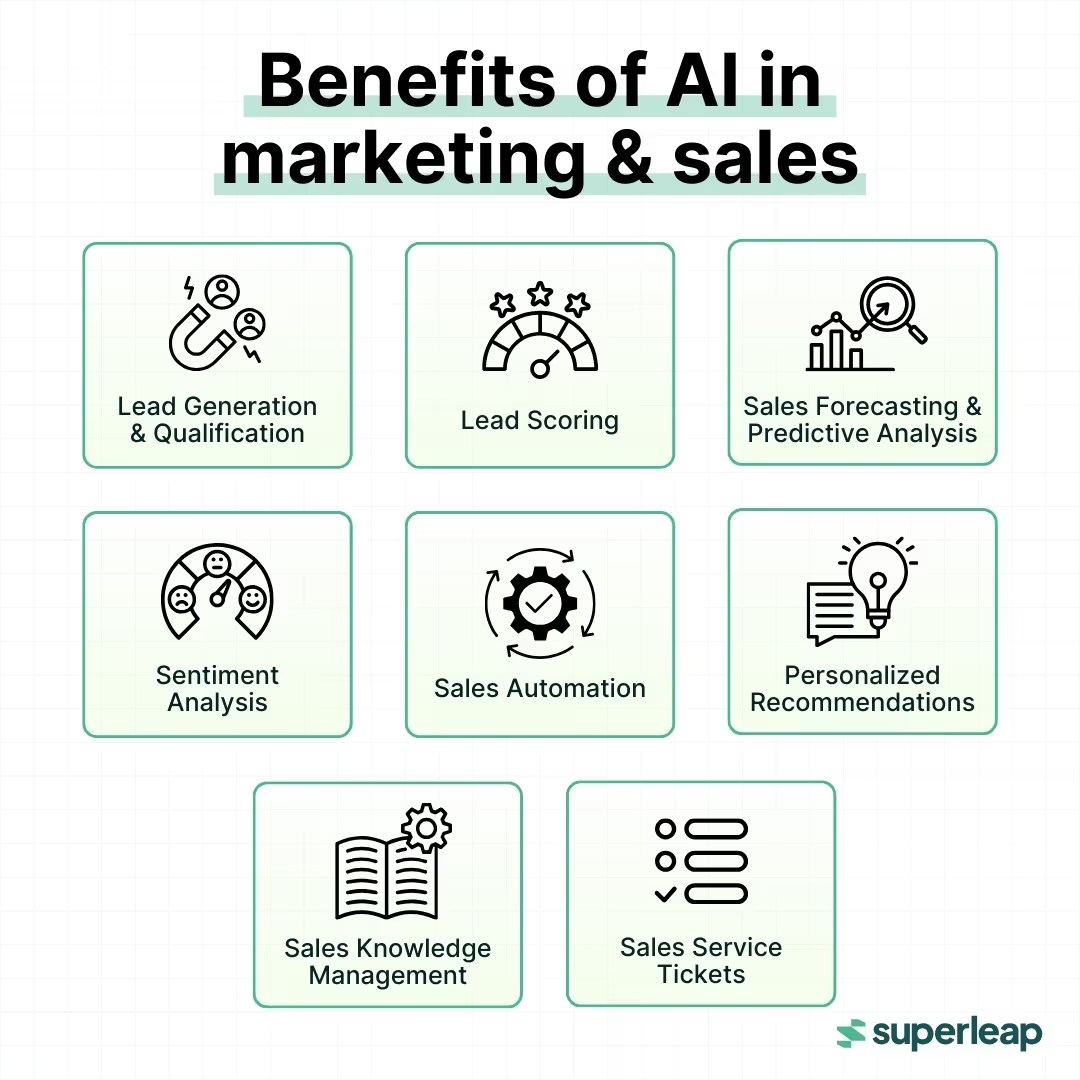
Lead generation & qualification
AI helps you cut through the noise by analyzing online behavior, social media activity, and prior interactions to find and prioritize real prospects.
Lead scoring
AI-powered sales prospecting and lead scoring can eliminate hours of manual work by ranking leads based on their behavior, past interactions, and likelihood to buy. Instead of chasing every lead, sales reps can focus only on high-potential buyers, cutting wasted time by nearly half and increasing close rates.
Sales forecasting & predictive analysis
With AI-powered tools like Gong and Clari, your team can boost their sales and budget forecasting with greater accuracy - helping you prioritize the right deals, course-correct before it's too late, and consistently hit your revenue targets with confidence.
For instance, Gong analyzes every sales call, email, and meeting in your pipeline. Let’s say your rep has 10 deals in progress - Gong can surface insights like which deals have gone silent, which ones involve decision-makers, and even whether your competitors were mentioned. This allows sales managers to coach in real time, adjust forecasts, and focus energy on deals that are most likely to close.
On the other hand, Clari pulls in data from your CRM, emails, calls, and meetings, then uses predictive analytics to flag risks in your pipeline. For example, if a key deal suddenly shows reduced activity or missing next steps, Clari alerts you before it’s too late - helping reps re-engage proactively. Many fast-growing SaaS companies like Zoom, Workday, and Databricks use Clari to improve forecast accuracy and reduce slipped deals at quarter-end.
Sentiment analysis
AI can analyze language and conversation patterns to surface signals such as sentiment, recurring topics, objections, unanswered questions, or changes in engagement. That is different from claiming that AI can fully understand a buyer's emotions or psychology.
Sales automation
Free your reps from admin work. Automate follow-ups, meeting scheduling, and CRM updates so they can spend more time closing. Sales automation and AI can work together, but they are not identical. Rule-based automation can handle predictable events, while AI can add interpretation, prediction, generation, or recommendations to the workflow.
{{callout-1}}
Personalized recommendations
AI can surface relevant products based on customer preferences. This helps reps tailor their pitches, boost engagement, and increase conversions.
Sales knowledge management
Centralize your team’s knowledge and give reps instant access to best practices, case studies, and product info - so they can ramp faster and sell smarter. It can also make this information easier to retrieve by answering questions in natural language, summarizing relevant material, or surfacing the content that matches a particular account or sales situation.
Sales service tickets
With AI-generated tickets, support issues don’t get lost. Your team has visibility into all interactions, which helps retain customers and close support-related upsells. This is more useful when viewed as a post-sale sales workflow. AI can help classify or summarize service interactions and surface account context, while the service team remains responsible for resolving the issue.
How AI is used across the sales funnel
AI becomes easier to evaluate when you look at what it is doing at each stage of the sales process.
1. Prospecting
AI can help research accounts, enrich available information, identify potential contacts, and prioritize which prospects deserve attention.
2. Outreach
Generative AI can help draft personalized emails or messages using account and interaction context, while sales automation can manage the surrounding sequence.
3. Qualification
AI can help score leads, analyze responses, identify intent signals, or support initial qualification conversations.
4. Discovery
Conversation intelligence can transcribe meetings, summarize discussions, identify objections, and highlight unanswered questions or next steps.
5. Deal management
AI can surface signs that a deal may be slowing down, identify missing actions, summarize the opportunity, or recommend where a salesperson should investigate further.
6. Forecasting
AI can analyze pipeline and historical data to provide estimates and identify deals or segments that may need review.
7. Closing
Generative AI can assist with proposals, quotes, summaries, and follow-up communication, while approval and commercial decisions remain with the appropriate people.
8. Post-sale
AI can surface renewal or expansion signals, summarize customer interactions, and help teams identify accounts that may need attention.
Transforming the way you interact
Forget cold calling, sales teams are now using AI to:
- Personalize outreach based on behavior and preferences with insights from a sales meeting.
- Reply instantly through chatbots
- Automate follow-ups so no deal slips through the cracks
- AI understands sales psychology helping you analyze sentiment and better understand buyer emotions.
- With all this at your fingertips, your interactions become more relevant, timely, and effective.
It should not, however, be treated as a replacement for the salesperson's understanding of the customer. AI can surface context; the rep still decides how that context should shape the conversation.
Industry specific AI applications
- SaaS Companies: A customer approaching a usage threshold could be surfaced as a potential expansion opportunity when product-usage data is connected to the sales system.
- E-commerce: AI can analyze browsing or purchase behavior to support product recommendations, segmentation, or personalized outreach.
- B2B Sales: A salesperson preparing for a discovery call could use AI to summarize previous interactions, identify open questions, and prepare a concise account brief.
Where to find AI in your sales stack
CRM
Use tools like Superleap to automate data entry, identify opportunities, and track all customer interactions in one place - so your team stays organized and productive.
Chatbots/virtual assistants
Let Botpress handle quick queries, schedule meetings, and qualify leads. These assistants improve response time and let your reps focus on more impactful work.
Call analysis & coaching
Gong and Chorus help you review calls, analyze behavior, and receive coaching tips, so your team gets better with every conversation.
Sales automation
Salesloft and Outreach automate email sequences and task reminders, strengthening your sales pipeline, giving reps more time for high-value selling and relationship building.
Forecasting
Use tools like Clari to forecast revenue, track deal progression, and reduce the guesswork in pipeline planning.
What sales teams gain from using AI
The impact is clear:
Increased efficiency
By taking over admin work, AI helps reps spend more time selling and less time clicking around.
Better ROI and lower costs
By targeting the right leads and automating outreach, you get more conversions for less effort.
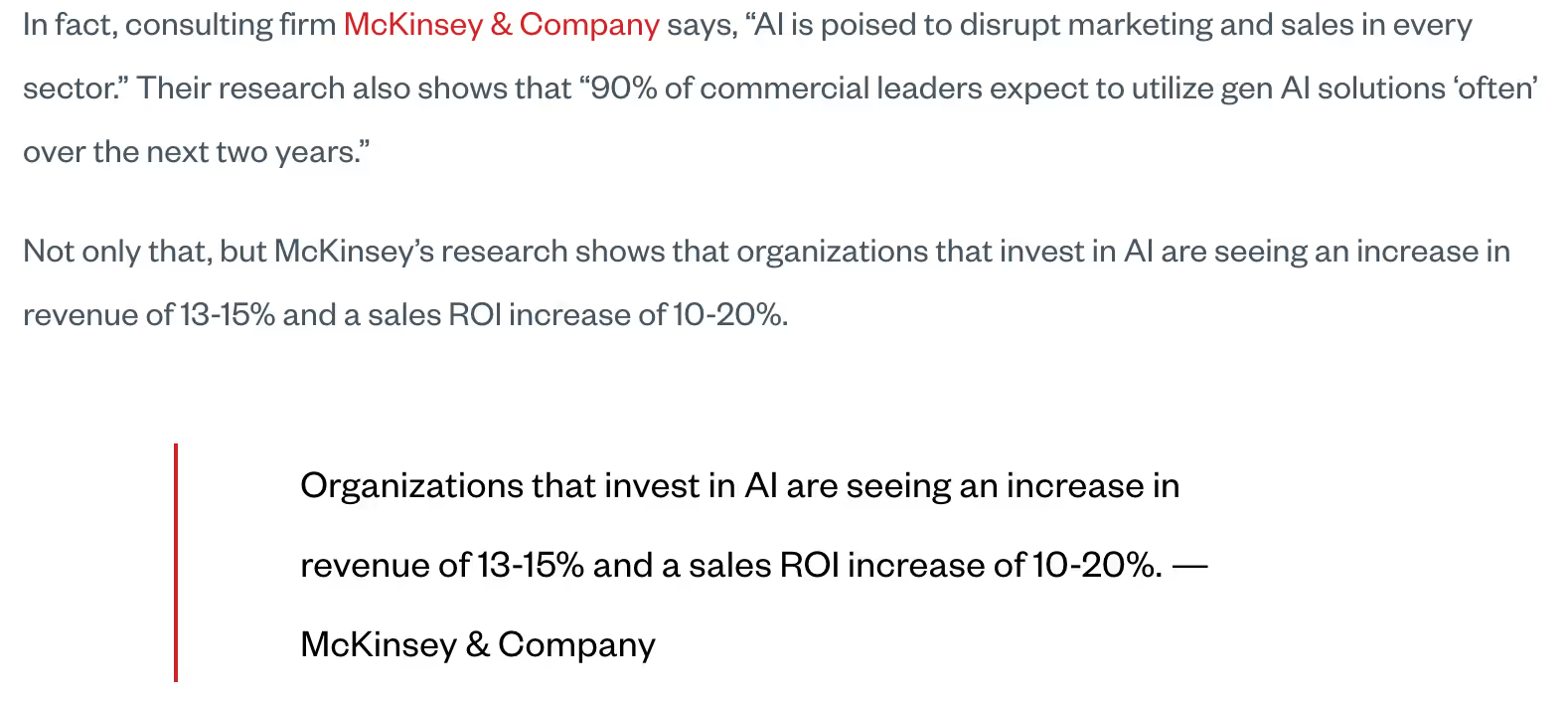
Better customer engagement
AI helps you speak to the right customer at the right time with the right message - that’s the trifecta of sales success.
Fewer repetitive tasks
No more chasing calendar invites or typing the same email ten times. Your reps can focus on what they do best - selling.
Less administrative work
AI can reduce time spent on repetitive activities such as summaries, data entry, research, routine drafting, scheduling, and CRM updates.
Faster access to sales context
Instead of reading through several emails, notes, or records, a rep may be able to use AI to create a concise view of the customer or opportunity.
More consistent prioritization
AI can help surface the leads, accounts, or deals that match defined signals, giving salespeople a structured way to decide where to focus.
Earlier detection of problems
Changes in activity, engagement, pipeline movement, or customer behavior can sometimes be surfaced before they become obvious in a manual review.
More scalable personalization
AI can help adapt messaging or recommendations to different accounts without requiring every piece of content to be written from scratch.
What can go wrong with AI for sales?
AI can introduce new problems when it is treated as an answer rather than as a system that still needs good data, controls, and human oversight.
Poor data can produce poor outputs
If CRM records are incomplete, outdated, duplicated, or fragmented across systems, AI may be working from an unreliable picture.
AI can be wrong
Generated summaries, predictions, classifications, or recommendations can contain errors. Important outputs should be checked before they influence high-stakes customer or commercial decisions.
Too much automation can damage the customer experience
A routine follow-up may be easy to automate. A complex negotiation, sensitive objection, or strategic customer conversation may require a human who understands the context beyond what the system can infer.
Privacy and security still matter
Sales systems can contain commercially sensitive and personal information. Organizations need appropriate access controls, data-handling practices, and vendor review before connecting that information to AI systems.
Adoption can fail even when the technology works
A recommendation that arrives too late, appears in the wrong system, or requires extra data entry may not be useful to the salesperson. AI has to fit the workflow, not merely exist alongside it.
How to get started with AI in sales
The easiest way to create an expensive AI experiment is to start with the technology instead of the problem.
1. Find the bottleneck
Start with one measurable problem: too much CRM administration, slow lead response, poor account research, weak call visibility, inconsistent follow-up, or difficult forecasting.
2. Check your data
Before introducing AI, make sure the relevant customer, account, opportunity, and activity data is complete enough to support the use case.
3. Choose one workflow
Do not introduce AI into every stage of the sales cycle at once. Choose one workflow where the benefit can be measured clearly.
4. Put AI where salespeople already work
An AI recommendation is more useful when it appears in the CRM, sales workspace, call workflow, or other system where the rep is already taking action.
5. Keep people in the loop
Have salespeople review important outputs such as customer-facing messages, recommendations, forecasts, or opportunity assessments where judgment matters.
6. Measure the result
Tie the AI experiment to the original problem. Measure time saved, response time, stage conversion, forecast accuracy, data completeness, or another relevant outcome.
7. Expand after the first use case works
Once the workflow is reliable and adopted, extend AI into another part of the sales process.
How Superleap supports AI-powered sales workflows
Superleap combines CRM data, sales workflows, relationship context, automation, and AI-assisted capabilities so teams can work from a more connected sales environment.
For sales teams, the relevant use cases are less about adding another AI feature and more about reducing the distance between information and action - for example, capturing CRM data, surfacing opportunity context, analyzing interactions, supporting follow-ups, and making useful signals easier to act on.
When evaluating Superleap or any other AI sales platform, the best test is to take one real workflow from start to finish: add a lead, capture the interaction, generate the relevant insight, take the recommended action, and measure what changed.
🦾 Sales teams lose hours every week updating CRMs, scheduling meetings, and sending follow-ups. According to Mckinsey, AI can automate 70% of that work, giving reps more time to do what actually matters: selling.




%201%20(1).svg)
.svg)
.svg)
.svg)
.svg)