


Sales teams often waste time chasing low-quality leads. A clear lead scoring and qualification system helps prioritize the right prospects and close faster.
This guide explains what lead scoring and qualification mean, how to build a scoring model, and frameworks to qualify leads better.
What is lead scoring?
In simple terms, lead scoring helps sales teams answer one question: “Who should we talk to first?”
There are two main scoring dimensions:
Explicit scoring: Who they are (industry, company size, role, location).
Implicit scoring: What they do (website visits, email opens, demo requests, pricing page views).
These scores allow prioritization. For example,
- >70 lead get a call from an SDR
- 49-69 will undergo lead nurturing
These scoring rules can be manual or automated using CRM or AI tools.
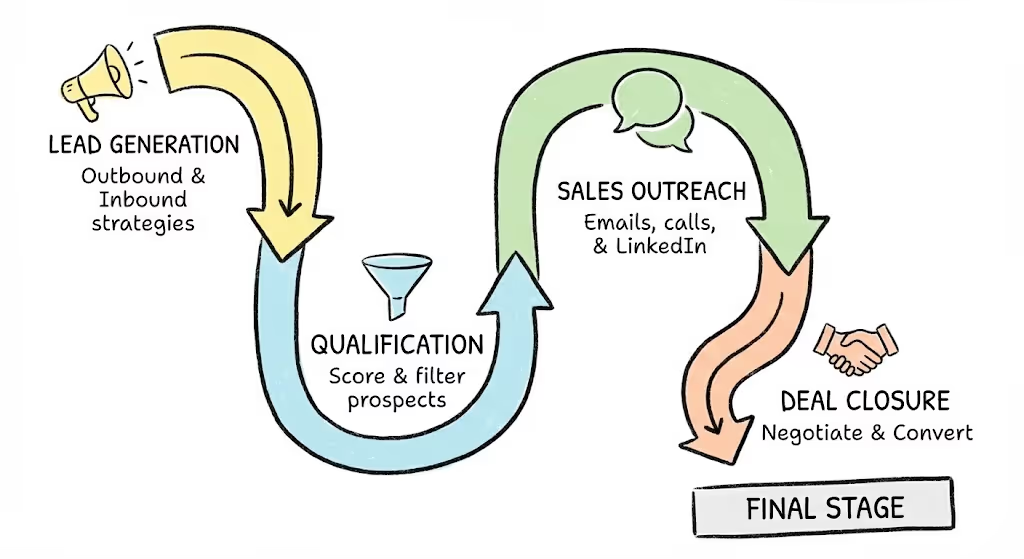
Where does lead scoring sit in the funnel
Lead generation > Lead scoring & lead qualification > Sales outreach > Deal closure.
What is lead qualification?
Ask yourself this during qualification: Is this prospect the right fit for our product or service? Rather than forcing a sale, this method allows careful screening and eliminates wasted effort on the sales front.
There are different stages of qualified leads:
- MQL (Marketing Qualified Lead): Shows interest, fits the ICP, but not sales-ready.
- SQL (Sales Qualified Lead): Engaged and ready to talk to sales.
- PQL (Product Qualified Lead): Has used the product (like a free trial) and shows high buying intent.
Qualification ensures only sales-ready leads are handed over, improving close rates.
According to Insidesales, 64.8% of sales people spend time on non-selling activities (customer support, prospecting, etc) due to lack of time management.
In this case, if lead qualification is carried out thoroughly:
- It increases selling time & improves sales performance
- Notable increase in deal closures
- Sales cycle is shortened
Lead scoring vs lead qualification
Lead scoring: How interested is this lead?
Lead qualification: Is this lead worth pursuing?
Remember, scoring uses data and behaviour while qualification is based on context and conversation.
Lead qualification frameworks you can use
BANT (Budget, Authority, Need, Timeline): Best for transactional sales.
CHAMP (Challenges, Authority, Money, Prioritization): Modern approach focusing on pain points.
MEDDIC (Metrics, Economic Buyer, Decision Process, etc.): Used in enterprise/complex sales.
Each framework gives sales teams a checklist to qualify leads consistently.
Note: Choose one framework consistently across teams to ensure alignment.
How to build a lead scoring model?
Here’s a simple 5-step process:
1. Define ICP: Who is your ideal customer?
2. Choose criteria: Firmographics (industry, role) + behavior (downloads, demo requests).
3. Assign points:
4. Set thresholds: 60+ points = MQL, 80+ = SQL.
5. Automate in CRM: Tools like Superleap CRM make this easy.
Regularly review the thresholds. If high scores aren’t translating into revenue, adjust the weights.
Sample lead scoring model
Note: Scores are examples. Customize based on your industry and funnel data.
Industry-specific lead scoring examples
Real estate lead scoring example:
High score signals include property page views, mortgage calculator usage, repeat location searches, and visit scheduling. Low scores apply to browsing-only behaviour.
B2B SaaS lead scoring example:
Key signals include pricing page visits, demo requests, product feature usage, and engagement from decision-maker roles.
Common mistakes to avoid
- Not tracking revenue by source and score (if higher scores don’t correlate with revenue, the model is broken)
- Treating every activity, for example, opening an email, as a high intent signal
- Scoring without involving the sales team (collaborate with SDRs and AEs to validate what high intent looks like)
- Not subtracting points for poor-fit leads
- Setting a model once, and never updating it
Conclusion
Start small. Define your ICP, pick 5 - 6 scoring criteria, and test it in your CRM. Even simple scoring can transform how your team prioritizes leads.





%201%20(1).svg)
.svg)
.svg)
.svg)
.svg)